


Letter #8: Manifesto for Sharing Online
- Nishita Mohta

- Oct 26, 2022
- 10 min read
Goa, 20th October 2022
Dear friend,
How have you been? I definitely missed writing to you in September and now, it makes me feel grounded again to be sitting at my desk, writing a new letter to you - the 8th one in this series.
The theme for each letter often comes from my own experiences of the month, and September was all about *sharing* for me. Between one design conference, one Pecha-Kucha talk and lots of one-on-one conversations, I got to share my past work with an audience that knew nothing (absolutely zero) about it till now.
Here's a nice photo from DesignUp that someone shared with me :')
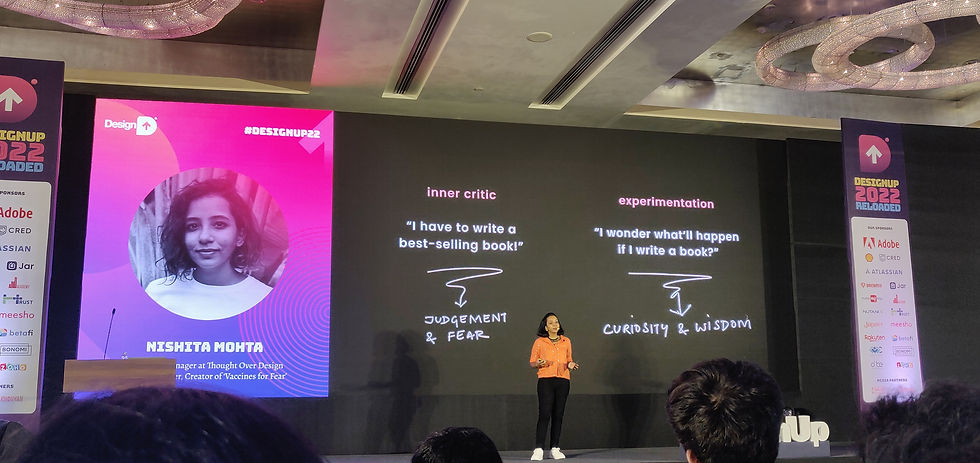
The one word on my mind for describing the month was: REFRESHING.
While I suspect I’ve grown into an introvert over the last few years, I can still talk about the creative process for hours on end. It was refreshing to be able to share my ideas, tools, methods & learnings with people after so long. I used to do a lot of it on Instagram. On my more enthusiastic days, I would think of my Instagram profile as a virtual studio space where everyone is welcome to observe & interact while I create and share both the processes & product.
But I feel that the social media fatigue has really caught on with me & the metrics associated with everything I share (posts, reels, and even the 24-hour stories) is making me feel like I need to “perform well”. Number of views, number of responses, number of likes, shares, saves & followers gained. It’s exhausting and I just don’t feel like doing much of it. In this season of life, I no longer feel like subjecting my effort & creative-spirit to the metrics. So my profile is now a bulletin board - a series of announcements of what’s happened.
The conversations in physical spaces were free from metrics, and I suppose that’s what made them refreshing.
But this is not a letter about hating on social media.
Because that’s what has enabled us to connect & stay connected to each other. Social media is still a place for our creative work to exist and to be findable. My project Vaccines For Fear was born on Instagram, and it led to the many things I’m grateful for today - including this connection with you (which goes beyond any other which we might even share in another part of our lives).
This letter is about shifting attention.
It’s 2022 & we all know that paying attention to the metrics and trolls and algorithms is JUST. NOT. HEALTHY. But like most unhealthy habits that we’re aware of - it’s easier said than done to break free from them. The journey from awareness to implementation is a long and difficult one. A few weeks back, I put out a poll on both Instagram & Twitter asking about how the metrics affect the frequency of sharing. Aishwarya was kind enough to share a reply which we might all resonate with:

We all know we shouldn’t strive for social-media-engagement, but striving for connection is a very human quality. We’re wired to connect. We create and we share with the hope of connecting. That’s why we start our projects & our brand new pages, with a whole lot of enthusiasm. And when the connection doesn't seem to happen, it's natural to be discouraged. No shame.
It’s also very difficult to “just ignore the numbers & keep going”. It is VERY VERY difficult. Not because we are weak, but because there’s a lot of science & money pumped into making the pull of these platforms very strong. They are designed to optimize for the attention-economy.
Human-attention is a scarce commodity… …which (like time) we possess by default …which (like time) is constantly-flowing, and …which we can sometimes choose where to direct. This choice of “paying attention” is sometimes made intentionally, and often unintentionally on auto-pilot. The platforms are smartly designed so that we “pay attention” to the metrics. And with a lot of focus being paid to the metrics, it can very quickly feel as if the whole point of sharing is to get higher numbers.
If you’re a content-creator aiming to monetise your skills OR a marketing professional trying to make your client’s profile feel legit on social media, then yes, caring about this number is part of your job. But if “social media growth” isn’t part of our job description, then there’s a high chance that these metrics are only sending us into an unhelpful mindspace.
The inner critic then gets the opportunity to say - “You’re not even getting a good response, you might as well stop putting this effort into captions and hashtags and even posting online”.
But… but… I WANT to keep sharing! Both online & offline! I don’t want to stop.
Sharing my creativity & taking part in that of others has been one of the most soul-filling experiences of my adult life.
Because of creating & sharing online, I built & became part of lovely communities of creatives. It gave me the sense of connection I craved at so many points of time in my life. Because of sharing my creativity online over 2 years, others saw me as an *artist* and that gave me the courage to start seeing myself as an artist as well. Because of sharing my creativity publicly, I’ve had novel professional opportunities come my way from people who saw something they loved. Because my creative work exists online, I’ve met people years later telling me that something I published on Issuu was really helpful to their own project.
So I cannot even begin to imagine a life where I give up on connecting and sharing, because the metrics have broken my spirit. I want to stop paying attention to the numbers, and I know it’s a looooong journey to really be free from their effect. But we’ve got to start somewhere and maybe this question is a decent starting point:
Since paying attention to social media metrics is bad for our creativity, where else can we divert our attention so that we feel enthusiastic about sharing again?
This is the question I’m reflecting on and, if it interests you, leaving it open for you to share your thoughts on as well, dear friend.
Regaining control of our attention (or even attempting to do so) is an act of rebellion when big tech is determined to control it for us. And this letter is a manifesto in the making.
A WIP Manifesto for Sharing my Creativity v.2022
One. I will pay attention to… how sharing my work shapes my creative voice. “You can’t find your voice if you don’t use it”. This is a line which stood out for me in Austin Kleon’s ‘Show Your Work’ because it resonates with my personal lived experience as well. Seeing my work out in the public space has often given me a fresh perspective on how I feel about it - whether it's because of the feedback & reactions, or because I’m once again able to experience it as a viewer instead of the creator. While I started creating art with my 30-days of digital collages, I also explored hand-drawn lettering & poster-making after that (which you’ll find by scrolling waaaaaay down on my Instagram profile). The making & sharing of these different styles allowed me to reflect on how I felt throughout the process for each. I decided I enjoy collages the most, and came back to them. I’ve also been trying to notice - which conversations do I enjoy the most, and what do I thus want to write about. “The trick is not caring what EVERYBODY thinks of you and just caring about what the right people think of you.” - Brian Michael Bendis
Two. I will pay attention to… the connections & conversations that grow from creative sharing.
Conversations on creativity have been the easiest way for me to make new friends as adults. I started Vaccines for Fear on Instagram in May 2020 and that conversation on fear connected me to way more creatives than I have personally known in my entire life. Exactly the kind of heart-warming connections that I needed in that pandemic state-of-mind.
It’s “social” media after all.
Neuroscience tells us that when we share ideas, values & passions with someone and feel connected, our brain releases oxytocin - the looove hormone which makes us feel warm & bright. (Yes, it's not just romantic love which is a source of these happy feels) So I guess it makes sense why we enjoy the attention & the feeling of connectedness that we feel on the platforms.
I heard the Hoodzpah Design sisters Amy & Jen Hood talk about their experience of using their creativity to connect on an episode of The Futur podcast. They had moved 4 cities before the age of 16 and knew how hard it is to build a community when you no longer have old friends around. But they also noticed that other teenagers in their school were very interested in the music posters that they used to make. They were able to make friends based on that new common interest, and even went on to organize meet-ups in their city around the topic.
What is the one interest that you’d like to discuss with more people?
Three. I will pay attention to… the community that already believes in me.
Some of us might be racing towards gaining 1k, 2k, 5k, 10k, 100k, 1M or the next big milestone of followers. I’ve been in that phase sometime last year for sure. The follower-count number shows up very prominently on our profiles and, if I’m being honest, I notice myself judging the profiles of others through this number too sometimes. I think about how legit they might be, how amazing at their work they might be, how many years they might have been working for…. All based on this one number. I assume, I judge & I then go onto comparing myself with them. All at a very subconscious level.
The numbers are placed SO prominently for us to see! It’s all in the UX design of the app. (Twitter is better than Instagram in this sense, and LinkedIn is slightly better than Twitter. But regardless of the platform, the numbers become something for us to aspire towards.)
We set goals for our next big follower-milestone, and try to share whatever it is that will attract new followers.
But these goals are fake.
Jason Fried & David Heinemeier Hansson are the founders of Basecamp (a product & company I admire) and they write about number-driven goals: “Nearly all of them are artificial targets set for the sake of setting targets. These made up numbers then function as a source of unnecessary stress until they’re either achieved or abandoned. And when that happens, you’re supposed to pick up new ones and start stressing again”
With that in mind, it’s helpful to our own state of mind if we can turn our attention to the people who already believe in us enough to “follow” our journey. How can we share something delightful or useful for the people who are already on this journey with us? How can we deepen our connection with those who have recently joined the journey?
Four. I will pay attention to… the long-term footprint of everything I share.
All my interactions at DesignUp & PechaKucha were a great reminder that the lifespan of a creative project is much longer than the 24-48 hours where it's receiving active love on social media. I loved being able to again talk about the work which was done 2 years back but suddenly felt fresh & relevant on those days.
The stuff we share on social media or portfolio platforms becomes our body of work and our representative in the world out there. It makes our skills & passions “findable”, incase they need to be found. More than once, I’ve had architecture students come up to me to share that they found my thesis book on Issuu or at the college library, and that they were able to use it to inform their own projects. That just blows my mind because I’ve done nothing to promote that book or anything since the last 7 years. I never even knew it would serve any purpose beyond my own final year jury. But there it is. Available for new students to refer to year after year.
Five. I will pay attention to… being thoughtful about how much I share.
As a creative with an online presence, you don’t have to share everything.
At the DesignUp conference last month, communication consultant Kartik Srinivasan said it as it is: “Trying to be your most authentic self on social media is bullshit.” This doesn’t mean we become fake and preach what we don’t practice. It means that we don’t force ourselves to bare our soul to the public. We don’t have to share “everything”.
“Everything” is what we reserve for our closest friends & family. The ones we can be in our shabby pajamas with. We do not share everything when we’re on stage at a conference, with our teammates at work, with our extended family, with friends-of-friends. With them, we change out of our comfy-shabby pajamas and into an occasion-specific outfit. Maybe even spray some deodorant if we care enough.
So why should we share everything on social media? Every time we post, we are on a stage - big or small. We can choose to share some thoughts & not share others. We can choose to share the work we feel good about, and not the one we’re already insecure of. I mentioned this long back in Letter #2 - “Think of how you’d treat a newborn - - with a lot of care, and precaution about who gets to meet them, right? Sometimes our creative explorations also deserve a little protection”.
Six. I will pay attention to… what others are sharing.
“What you want is to follow and be followed by human beings who care about issues you care about. This thing we make together. The thing is about hearts and minds, not eyeballs.” - Jeffrey Zeldman
Sharing isn’t just about sending out things into the world. It involves give & take, and we don’t only have to take up the responsibility of “giving” in order to participate in the “sharing”. We can take time to cherish what we’re receiving from others through their creative work - by participating in the conversations started by others, and by adding meaningfully to them. Even by hyping up the work done by others which we’re enjoying!
However, this doesn’t mean that we try to engage with everyone. Just the other day, I saw a post by one of my favourites Michelle Poler, where she named ‘Mute’ & ‘Favourite’ as the two important Instagram tools for mental health. Based on personal experience, I can vouch for how effective these tools are, and I’d add the third & fourth ones as well: Unfollow & block.
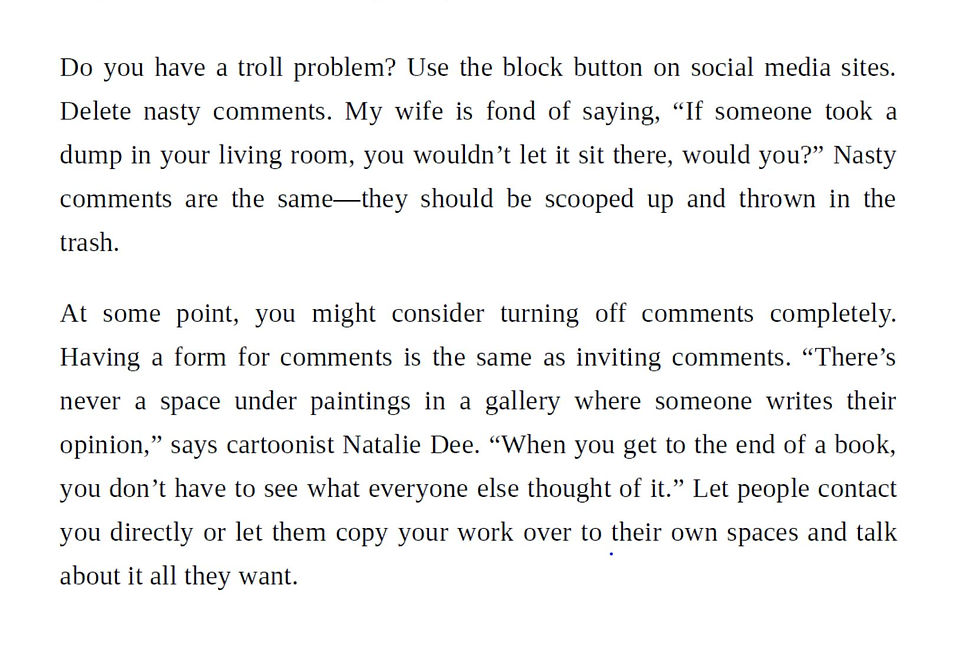
When we pay attention to what others are sharing, we might start becoming more conscious about how it’s making us feel. Is it making us feel nourished or entertained or joyful? Is it keeping us well-informed? Is it making us feel irritated, triggered and doubtful about our own selves? Is someone leaving inappropriate comments on your work? (All publicity is NOT good publicity if it takes a toll on your mental wellbeing). When we become mindful of this aspect of sharing & consumption, we can then take action to maintain the kind of mindspace that you prefer.
An excerpt from Show Your Work (yes, again) which made me chuckle:
Seven… Hey, what else would you like to pay attention to?
I always love hearing back from you on these letters. Do write back if something comes to mind and we’ll continue building this Manifesto together.
Before I sign off… Here's a TED Talk from 2011 about creating & collaborating online before creating & collaborating online was a mainstream thing: A Virtual Choir 2000 Voices Strong
Hope you enjoy it!
Nishita


Comments