


Letter #5: Breaking up with Perfectionism
- Nishita Mohta

- May 16, 2022
- 5 min read
Goa, May 16 2022
Dear friend,
This month’s letter comes to you much earlier than usual. I’m very excited because this is part-announcement, part-introspection & part-invitation.
Let’s start with the announcement because I’m not a fan of holding onto them till the very end…
‘Vaccines For Fear’ is evolving!
Over the last 2 years, this project has given space to all our big emotions. What started as a one-person project in self-expression became my reason for authentic connection with all of you. Your responses to the artwork & your readership of my letters has been a constant reminder that we have to talk more about fears & mindblocks together, instead of allowing them to lurk in our individual shadows. This is the conversation that I want to continue fueling with my work.
For a conversation to grow stronger, it needs to have more voices than one and more languages than one.
It’s true that I’m in love with and SO proud of the project’s name Vaccines For Fear, as well as the language of the artwork (two succinct sentences & a surreal collage). They make me feel like “oh this is my voice” - a quest that many creatives set out on. Simultaneously, it’s also true that I now find them a bit restrictive. For a few months, I tried not to feel that way, and went back & forth with myself questioning it.
“You’ve finally become good at something. Stick to it.”
“You know you have a tendency to keep pivoting. This isn’t good for you in the long run.”
“It’s such a unique name & format! People now finally recognise it.”
“You’ll regret changing it”
“You have to be more rational.”
It took me a while to recognise this, but after 5-6 months of grappling with these voices, I realised that rationality wasn’t the problem at all.
By changing the nature of this project, I was afraid of being bad at something new, and also losing the connection which I’d built with everyone along the way. The real question which my Inner Critic wanted an answer to was:
“What if people stop resonating with the work?
“What if they don’t like you anymore?”
Under the guise of rationality, there was a people-pleasing perfectionist lurking at the back of my head.
It hurts to even acknowledge this, but this realisation shook me to my core!
“Don’t I already know that perfectionism is not a helpful quality at all? How am I still doing this after all that introspection on fears & mindblocks?! How?! Why?!”
Calm down, Nishita.
Moments (or month-long phases) of perfectionism can creep up on any of us. Even if we’re fairly self-aware & don’t identify as a ‘perfectionist’ in life generally. Living in a multi-layered society means that we’re constantly faced with demands in subtle and obvious ways, and the desire to respond well to a demand is only human. Arundhati Ail points out: “(the) dimension of perfectionism is especially important in the Indian context, considering the value placed on family expectations and academic or professional achievements… factors like collectivism, family obligations, and discrepancies between personal and family expectations inevitably find their way in. ” I couldn’t agree more with you, Arundhati.
“You’ll get <insert child’s favourite treat> if you score a 100 in Maths.”
“Won’t you do this if you love your aunty?”
“Top 1 percentile will be awarded….”
Stories of conditional appreciation can be found in every corner. It’s great to be appreciated for doing well. But not so great to be appreciated only if we do well. Getting rewarded for achievements can become a burden even if we're high-achievers, because we then feel an overwhelming pressure to live up to our glorious history.
Years after we’ve graduated from school and college, life can continue looking like an endless series of exams with scary report cards & parent-teacher meetings scheduled for later. And this can push us to focus only on the end product, not on the process of learning itself. Competitive work environments & social media add fuel to the fire, encouraging a sense of dissatisfaction which makes us want to appear more and more successful.
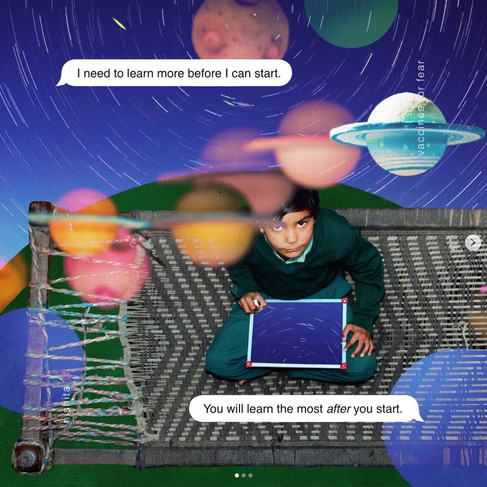
Sometimes this might be mistaken for a growth-mindset, but can actually be self-defeating behaviour which makes it harder (not easier) to achieve goals. Why? Because Perfectionism brings with it a friend called Procrastination. We may find ourselves saying stuff like “I need to know more before I can start” or “I’m too busy for this right now”. At the core of these mindblocks is the fear of doing things badly. And so, we don’t start. I can’t be bad at something I don’t start, right? ;)



Prof. Paul Hewitt is a clinical psychologist who has worked with many patients suffering from the extremities of perfectionism & written about the topic in his books as well. While studying his own profession with his colleagues, they found that among 1,2000 psychology professors, those who strive for perfection and hold unrealistic expectations for themselves were less likely to produce publications, receive citations, and publish in high-impact journals.
Not to be dramatic or anything, but I feel his overall description of perfectionism paints a pretty solid picture:
[Perfectionists] are hugely hard on themselves, with a hatred that is breathtaking at times. Perfectionistic people will treat themselves with a harshness on par with “a nasty adult beating the crap out of a tiny child.”
Yikes. Gory, right? But it’s true. In the name of perfectionism, we subject ourselves to harshness which we’d never inflict on anyone else. (Assuming you and I are mildly conscientious at the least).
Breaking up with perfectionism doesn’t mean that we need to stop setting goals for ourselves or bothering with any self-improvement at all. Perfectionism is very different from healthy striving towards growth, and Brene Brown captures this difference in her book ‘Daring Greatly’:
Healthy striving is self-focused: How can I improve?
Perfectionism is other-focused: What will they think?
As someone who’s swinged all over the hustle and self-care spectrum, sometimes losing sight of the “what” and “why”, I really like the clear distinction she’s laid out. Keeping this in mind might help us balance between extreme hustle and extreme self-protectiveness, by becoming a way to check-in with ourselves when something feels off.
There’s a lot more to learn about bringing more self-acceptance & self-compassion into our journey of growth.
And turning those learnings into action is another journey ahead of us.
But we’re all in it together.
And personally, my first step would be to embrace change once again.
So… yes, Vaccines For Fear is evolving. It’s evolving from a one-person art project, into a playground of experimentation & imperfection for all of us.
You may remember this artwork 👇 It’s my personal favourite from everything I’ve created over the last 2 years.

In hindsight, I see that ‘perfectionism’ is one of the biggest fears which can hinder our creative journey. So going forward, the mindset of ‘experimentation’ is something that I really want to lean into and embrace fully.
You’ll see this reflect in the new name for the project and in the new forms of experience-sharing that happen along with it. While the fear of fucking-up still exists quietly in the background, I choose to give this a shot anyway. What if this turns out to be really lame? I’ll live through it. But what if everything turns out to be really great? We’ll never know without experimenting.
An invitation…
Going forward, I’ll also be featuring other people on the Instagram and LinkedIn pages for this project as well. As a run-up to that, I am looking to speak with and learn from other creatives who’ve taken up mini-experiments and personal projects of their own. If you’re one such person, drop me a message and I’d love to chat directly with you.
See you on the other side!
Love,
Nishita



Comments