


Letter #2: On creative companions & poisonous playmates
- Nishita Mohta

- Feb 19, 2022
- 6 min read
Updated: May 13, 2022
Goa, February 19, 2022
Dear friend,
I’ve been making a digital scrapbook with photos clicked by my 87-y.o. grandfather ❤

My cousins and I have been encouraging him to make a photo-a-day project and these are some of his creations. In the last one month, he's learnt how to click using his phone camera, and how to share photos on this WhatsApp group with his six grand-children.
It’s our own little social network.
Photos of flowers. Photos of his house. One selfie. A little bit of enthusiasm. A little bit of nudging. A lot of “wow”s and “beautiful”s.
We don’t chat much in that group, but the photos give us some more topics of conversation for our daily phone call. Something about the photo he clicked that day. Some ideas on what to click next. Something about what another kid commented.
Dada: “She wrote ‘damn’ on the photo.”
Me: “Dada, that’s good only. It just means she was surprised.”
All in all, the last 15-20 days have been fun, because we all have something new to connect over.
It reminds me of designers Amy & Jen Hood (I’ll link the podcast at the end of my letter for you), talking about how they were really awkward, shy teenagers who frequently moved schools. And creating art was their way of having a topic of conversation with the others in their school. They would design album covers and posters and other such conversation-starters, which helped them connect with way more people their age than they otherwise would.

Fascinated by their experience, I started thinking about all the ways in which my own personal project ‘Vaccines for Fear’ has connected me with people during a specially isolating period of all our lives. ⚡️ The artwork became a conversation-starter, with which Instagram-strangers became Instagram-friends. ⚡️ Sweet notes from friends and strangers became words of affirmation on days when I thought “what’s the point of all this”. ⚡️ Even before the project started, I’d enjoy jamming with close friends on ideas. It was such a great distraction from the first lockdown! ⚡️ A friend become my self-appointed accountability partner for me during the first 30-day project in May 2020. When I started slacking out, I'd get messages like: “I’ve been keeping an eye”, she said, “and I don’t see today’s post on your profile”. Humans are, at the end of the day, a social species and I feel it’s natural that our personal projects become social experiences.
Our brains are very attentive to the people around us. While the intensity varies for different people, everyone has someone or something they pay attention to. Did you know that the brain changes its “wiring”, little by little, after every new experience? I find this process of neuro-plasticity really fascinating because it means that there’s scope for change and a better life-experience. To someone like me who’s had a lot of bad habits in life, knowing this is a big relief. What it means for our creative self is: Conversations and experiences regulate our minds on a daily basis. Our words have a direct effect on each other’s brain and bodily functions. But here’s the catch…
“It’s the fundamental dilemma of the human condition: The best thing for your nervous system is another human and the worst thing for your nervous system is another human.” Lisa Feldman Barrett PhD
Our nervous system and, thus our experience as creative individuals, is bound up with the behavior of other humans - for better or for worse. While a compliment at the end of a hard day can calm us down or inspire us, exposure to verbal aggression, big or small, taxes our body and injures our brain. We’re not weak, we’re just human. I’m letting you all in on a secret… The deep truth of why I create Vaccines For Fear is because I’ve personally felt deeply discouraged and unmotivated by those around me in the beginning years of my professional life. Most of the words of consolation in VFF artworks are pretty much love-notes to soothe my younger self. This discouragement never came from strangers, because they hardly have an impact on me. You know that song.. “Kuchh toh log kahenge, logon ka kaam hai kehna” [People will keep saying things because that’s just what they do] The experiences which damaged me the most involved people who knew me very well, and who attacked where it hurt the most. My deepest flaws (invisible to the general public) were highlighted. My wins tsk-tsk-ed. My ideas were belittled and capabilities questioned. I now understand that their actions came from a place of their own insecurity, but 4 years back, I didn’t have that perspective & it made my self-confidence and self-acceptance dip to rock bottom. I was “made to believe” that I was doing things for the wrong reasons, and that I was a bad person. “Made to believe”? Surely they couldn’t have entered my brain and reset my neural networks to make me see myself differently?! But their words surely could. And that’s the power of words. Creativity flourishes when we have a sense of safety and self-acceptance. And as a social species, our society has a lot to do with it. The author Julia Cameron speaks about “poisonous playmates” and “crazymakers” - the people in our close environment who find our creative growth dangerous to their own selves. One such “crazymaker” in my life was a very brilliant creative friend who I respected a lot at that time. (I share this experience with you not for venting, but as a set of red flags that I’d like my close ones to watch out for.) I took his words as advice and, naively, as “the truth”. While he did help me grow in some ways, he was also prompt to shut down any big ideas which didn’t seem convenient to him. The intense skepticism in his voice was labeled concern. The discouragement was disguised as feedback. The brutality was disguised as honesty. This sabotaging went on for a couple of years before a majorly dramatic breakdown, and eventual breaking-free. Over the years, I’ve learnt that it’s important to filter the feedback we receive.
Think of how you’d treat a newborn - with a lot of care, and precaution about who gets to meet them, right? (especially during a pandemic!)
Similarly, sometimes our creative explorations sometimes deserve a little protection. Especially when our ideas are at a very nascent stage, we have to be aware of our well-wishers who challenge us to grow and equally aware of our poisonous playmates. We need some space to make mistakes and not have them called out. We need time to explore & evolve without being called inconsistent. We need to fall a few times in private before we gain the confidence to do so in public. We need to feel joy in our practice before we need fame or followers. We need considerate feedback from a few people, before we get ready for brutal feedback from many. We deserve all that. Dear friend, please allow yourself all that. ❤
An invitation to explore: Are you thinking about the creative companions & poisonous playmates in your own life right now? You might like to use this format to reflect on it: (adapted from Chapter 2 of The Artist's Way - a course in discovering or recovering your creative self)
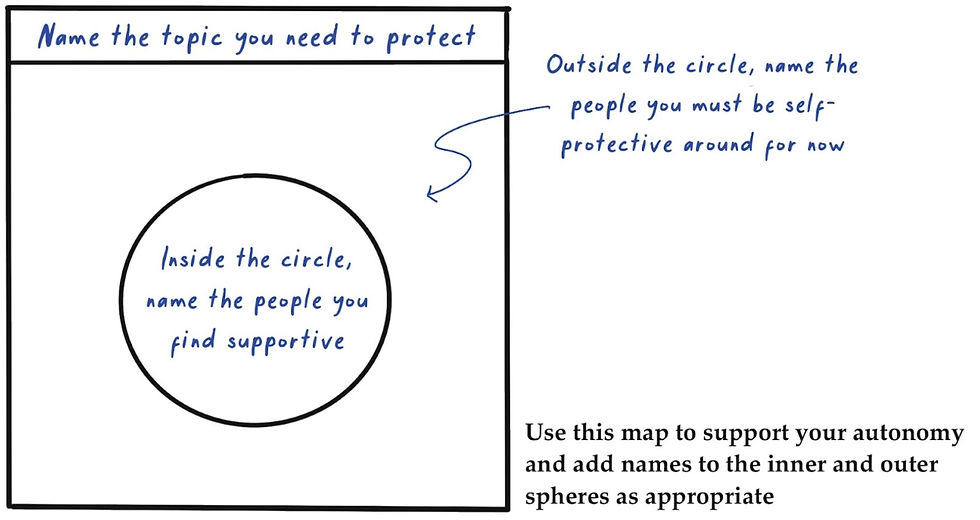
It’s helpful to keep in mind that none of these labels are absolute or over-arching. The same person might be very close and supportive in one aspect of life and a poisonous playmate in another aspect. For that reason, you may want to make this diagram for different topics in your life. For example, some of my topics would be: Vaccines For Fear in general (open to sharing most publicly), Brain Food letters (very limited sharing circle), personal life (again a tiny sharing circle), professional work (somewhat larger circle but with a different set of people who “get it”), and so on… Once we’re aware of ourselves, our interests and the nature of our social circles, we can be more mindful of how we share our interests and with whom. 🍋
I have been listening to a lot of podcasts about “personal projects” earlier this month. I’ve created a playlist on Spotify: Personal Projects Playlist, by Vaccines For Fear If you liked that quote from Lisa Feldman Barrett, here’s the rest of her article: People’s words and actions can actually shape your brain — a neuroscientist explains how The podcast where Amy & Jen Hood spoke of their childhood experiences: ‘Start Before You’re Ready - with Hoodzpah’ | Episode 169 on ‘The Future with Chris Do’
Before I sign off... I LOVE receiving your replies. My inbox is always open to your thoughts – feedback or thought on this letter, about VFF, about YOUR creative project and all things creative. If you don’t want to receive these emails, for any reason, please feel comfortable hitting ‘unsubscribe’ in the footer. No hard feelings! Take care of yourself Love, Nishita

Comments