


Letter #6: Journaling practices for creatives
- Nishita Mohta

- Jun 30, 2022
- 9 min read
Goa, 30 June 2022
Dear friend,
We’re at the halfway mark of 2022. And with my sixth letter to you today, we’re also at the halfway mark of all the letters in the Brain Food series. These mid-points feel like a good time to reflect, because we have as much to look forward to as we’ve already experienced.
Looking back at everything that I’ve written about this year, I realize I’ve been skipping a topic that was almost going to be Letter #1 because it’s such an integral part of my everyday life, and of my creative practice.
And the topic is.. *mini drum roll* - Journaling!
I might have occasionally shared photos on social media, or talked about it to some of you. But I don’t think any of it really communicates the value I place on this tool and how it’s led me to create projects like Vaccines For Fear.
Have you ever had a journaling practice, Nishita? Maybe a “Dear Diary” for the summer holidays as a child, or a daily task list that’s been maintained regularly, or maybe a dream journal?
I’ve heard of as many forms of this practices as the number of people who do them. The simplest definition of “journal” as a verb is: to write in a journal or diary. Given this broad definition, it’s no surprise that we see so much diversity in what gets considered under this umbrella term of “journaling”. I see both colourful collages & functional grids on Instagram and Pinterest. I see the notebooks on my friends' desks - some preciously maintained and some worn out with use. I see my own handwriting spread across loose A4 sheets folded into an envelop for safe-keeping. And I absolutely love them all.
Great creative work comes from a combination of deep inspiration & organized execution.
And I believe that all these different forms of journaling help us be intentional about both of them. So in this letter, I’m writing to share my personal experience with the five forms of journaling that I’ve been using as tools for my creative practice. (You'll also find some selected reading material for you in case you’d like to learn more about any particular form and try it for yourself.)
This June, I did a lot of freewriting to beat the brain fog that’s been following me around. So let’s start with that one.
Freewriting has traditionally been considered a pre-writing exercise for writers, to kickstart a free-flow of ideas. And yes, I swear it helps me unblock everytime I’m struggling to figure out what I “really want to say” in one of these letters. But even beyond writing, this is my go-to tool for “having a conversation with myself”.
I started doing it regularly when I learnt about Morning Pages in the book The Artist’s Way. Over the last 3.5 years of doing it (more or less) regularly, I’ve started seeing it as a check-in with myself. I check-in with my office team daily, so it only makes sense that I check-in with myself just as often, if not more.
Every morning, I brush and make a cup of hot water or green tea, and sit down to write three pages of whatever the fuck comes to my mind. “What will I write?” is a big question for many in this form of writing and the answer is: “whatever the fuck comes to your mind”. I ramble on about everyday stuff, I vent, I start seeing my mindblocks emerge on the page, I soothe myself, I come up with really fun ideas…all of this in no particular order. I have learnt not to have any expectations from the pages but just go into them as I would start a casual conversation with my bestest friend on the planet. With an any-thing-can-happen-attitude.
This is the form of journaling which I think is really for everyone! It’s the one which takes the most effort, simply because we’re not used to sitting with our thoughts, but also reaps the most rewards (some clarity & peace of mind over time). Even after 3.5 years of doing this, I need to make an intentional effort to get myself to my desk instead of snoozing 45 minutes extra. I doubt this is something which will ever become an automatic habit. But it’s a ritual that I value, because it makes me feel like I’m spending some intimate time in conversation with myself.
I’ve also written a set of crisp Reminders To Self based on the book chapter & my experience with writing the morning pages:
REMINDERS TO SELF FOR FREE-WRITING

This is not artistic, beautiful writing.

It’s a brain-drain of everything that stands between us & creative flow.

We’re using this check-in to vent and to dream without judgement.

These are not meant to be shared with anyone.

Even when it looks pointless, its an investment into the quality of my day.

Practice navigating self-judgement.

We’re free to write whatever comes to us - remarkable observations and mundane venting alike.

There’s no wrong way to do the morning pages.
|
The second form of journaling that I want to write about is a close cousin of freewriting.
Writing with prompts is a great approach for when you know you want to address something specific - whether it's a challenge that needs to be resolved or a win that you want to celebrate. As compared to the anything-can-happen-approach to freewriting, I see this as a more structured approach.
This isn’t something I do with any kind of regularity. If something in a book or online feels too-damn-relatable for my own life, I might pull out my regular journal and start writing about it. Sometimes my therapist gives me prompts to write to help with reflection on pretty specific areas of my life.
While journaling with prompts, I try to write in the same care-free, judgement-free manner that I’ve gotten used to through my morning pages. But I make sure to circle back to the topic at hand in case my thoughts take me a little toooooo far. Like, if I start thinking about my next snack instead of the perfectionist tendencies which wreak havoc in my life. That far. :P
So… when I created the Journaling Kit last year with those 12 selected prompts for addressing creative mindblocks, the intention was to share ‘starting points’ which can really help kickstart some thinking in the face of brain fog or a dilemma. I personally have found it easier to relate to the voice of fear and use that as a starting point for reflection. The voice of wisdom in the artworks feels more like a ray of hope.
You can find all my artwork through the ‘Guides’ at @the_experimentor and incase you want to check out a broader set of prompts, head over to this article :)

Next up is a form of journalling radically different from free writing & writing with prompts. While the last two work really well for my ideation process & emotional/creative unblocking, the next one is my friend for task management.
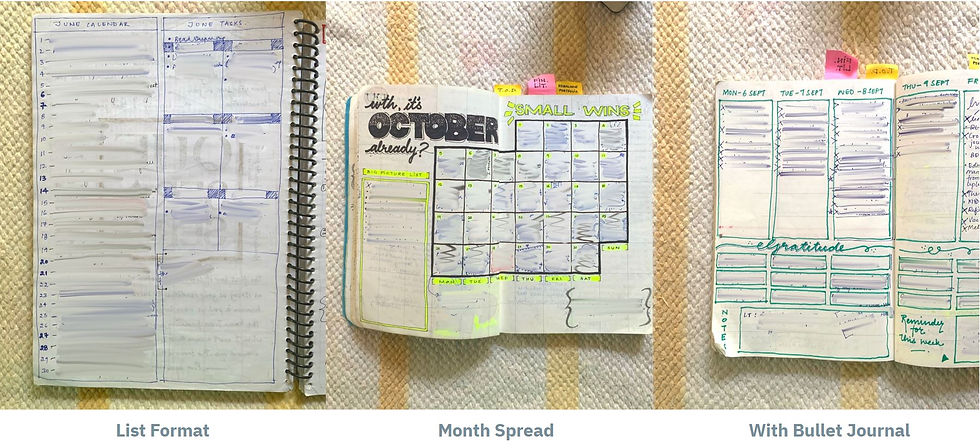
Bullet Journaling, a method introduced by Ryder Carroll, is wildly popular across the world. I’ve always been a list-maker in life, but this method has helped me get an even better grip on my to-dos for each day and week - both on the professional & personal front. I really enjoy drawing out different layouts every week, depending on what I feel I need to track - which may include daily and weekly task lists, monthly goals or wishes, certain habits, birthdays, events and even sometimes include gratitude within the weekly spread.
I don’t want to get too much into the method itself because Ryder has a phenomenal video on their website explaining it. (Just click on the ‘Watch Free Tutorial’ button on the Bullet Journal homepage)
But what I do want to address is 3 of the common mindblocks against Bullet Journaling which people have shared with me over time. The first hesitation - “I’m not artsy enough to draw these spreads”
Yes, Bullet Journaling has become an artform for many, and that's great. We can never have enough beauty around us. But prettiness isn’t the point of this tool. Don’t let it be a reason for overwhelm. The point is to be super functional first. Once you watch the video linked above, you’ll see what I mean :)
Here are some really well crafted "BuJos of Instagram" vs plain-but-perfectly-functional "BuJos of Nishita" from my own notebook:


The second hesitation - “There are apps for everything. Who writes in a notebook today?”
Writing helps us remember more, and that’s a fact. Also, when we carry over tasks from one day to another in the bullet journaling method, we’re able to quickly spot tasks which have been overdue for a little too long. I also feel that a quick scribble in the journal is the fastest way of making a note about the work and it’s so easy to revisit. And ofcourse… The dopamine hit of crossing off a completed task is amazing.
The third hesitation - “Isn’t time-blocking considered the most efficient way to work? Why write lists.”
I swear by time blocking 80% of my days - not just for work but also for marking off my rest and recreation hours. However, I always need to have a bird eye view of my tasks before I can prioritise and start assigning time to it all.
Bullet journaling also becomes a sort of personal record for the day & week. It’s kinda fun to go back to older journals and see what I was upto at a particular point of time in my life (specially because I write personal tasks in my journal too, not just professional ones). How many times have you encountered this thought… The week just flew by, I have no clue what happened. This can help with that. And so can the next form of journaling… at a slightly more emotional feel-good level.
Gratitude Journaling is a daily-tool I use for acknowledging the good things - about the day gone by and gratitude for what has been.
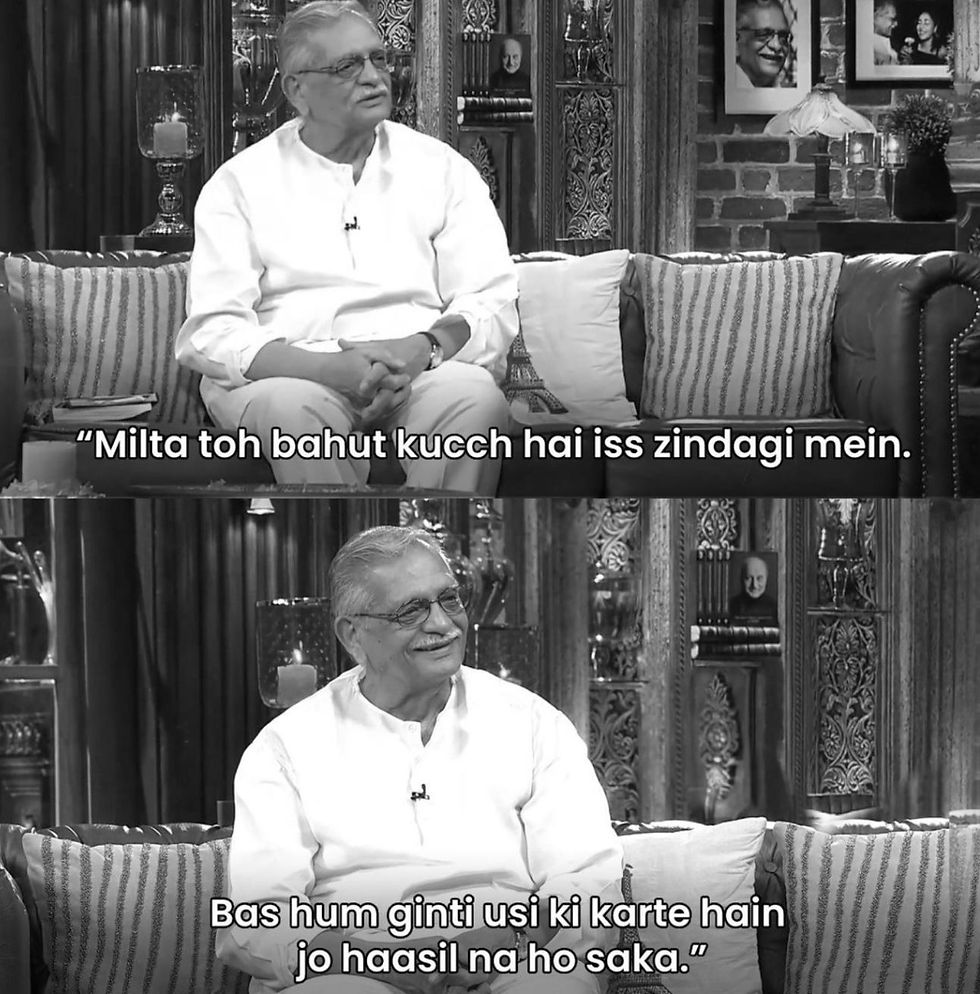
I’m someone who gets low on energy and slightly grumpy by evening-time. My situation is an amplified version of how the human mind is anyway wired to focus more on unfinished business than on our achievements. But that tendency is a part of the self-protective primitive mind which doesn’t necessarily serve us anymore, at least not on a day-to-day basis and to the same extent. It only makes us more anxious. Gulzar-sahab articulates this scientific fact more poetically (apologies in case Urdu isn’t understandable for you. Just scroll by. But I really wanted to include this here)
So starting June 2020, I’ve been maintaining gratitude journals to help me make sense of the day in a slightly uplifting manner. It started as a hand-written/drawn form of journaling in a notebook - and I kept changing the format for each month, whenever a new idea came my way.
Very recently, about 50 days ago, I transitioned into a digital format simply because I found a really beautifully-made app which I felt like using. It’s called Presently, for anyone who wants to check it out. (You can get a glimpse of its screens on this link)
Speaking of beautiful things, I'll come to the fifth form of journaling that I want to share with you. Everyone calls it by different names, so I’m again just going to use an umbrella term which makes sense for the sake of this letter to you.
Experience Journaling is something I turn to when I live through something so inspiring or moving that my brain goes - “I like this. I want to remember this”. I sketch, write, doodle, collect, paste. It’s something I see as an artform, but I guess that perspective can also make it daunting to do this sometimes. So I like to continue seeing it as a souvenir-making exercise. My journal spreads aren’t pretty or instagrammable at all. But they make sense to me and they hold a lot of meaning for me. Often only to me. Those scraps of paper and hand-drawn doodles let me relive my travels, creative experiments, food experiences, an amazing day out or a whole exciting month gone by!
When I journal about an inspiring experience, it can also serve as a piece of inspiration for future work. Taking time to document inspiration in your own medium is a great next step to just pinning it on Pinterest.
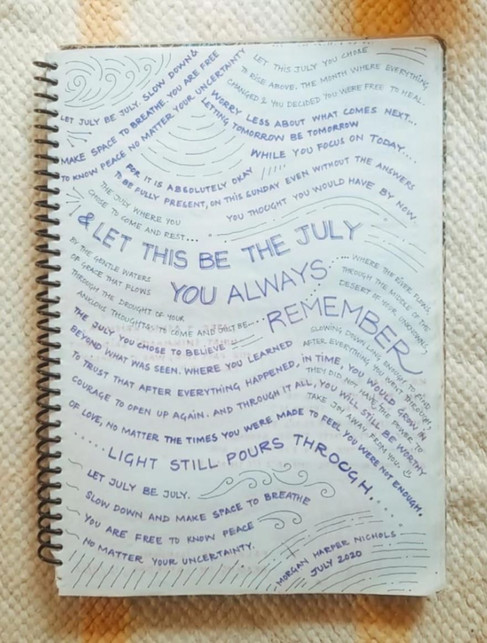
Again, here are a couple of journal entries that I've not posted about but which really fill my heart every time I look back at them. (First - journal entry from Naggar (2020) with an ink-sketch, a hand-drawn bill, an India Post receipt & the ticket to Roerich Museum. And second - Journal entry drawing out the words by Morgan Harper Nichols - from the poem 'Let July be July' which I loved a lot!)



So yeah, those were my five forms of journaling.
Freewriting to get me ready to face the world each morning.
Writing with prompts to reflect on directions that I won't pick otherwise.
Bullet journaling so that no task slips through the cracks.
Gratitude journaling to end my day on a decent note.
And experience journaling to create my own souvenirs of life.
Have you been using any of these tools recently? I’d love to hear about how you see them because I’m almost certain we’d have unique perspectives on this which would be interesting to chat about :)
Do you want to start off with any of these? I’m here as your cheerleader! Feel free to reply on this mail anytime you need a soundboard.
I hope you’re taking very good care of yourself. I’ll see you in my next letter.
Love, Nishita


Comments